
Araghchi: We are Ready for Diplomacy
The Foreign Minister of the Islamic Republic of Iran emphasized: "We are ready for diplomacy, but diplomacy is incompatible with intimidation and threats; in fact, diplomacy has its own principles."
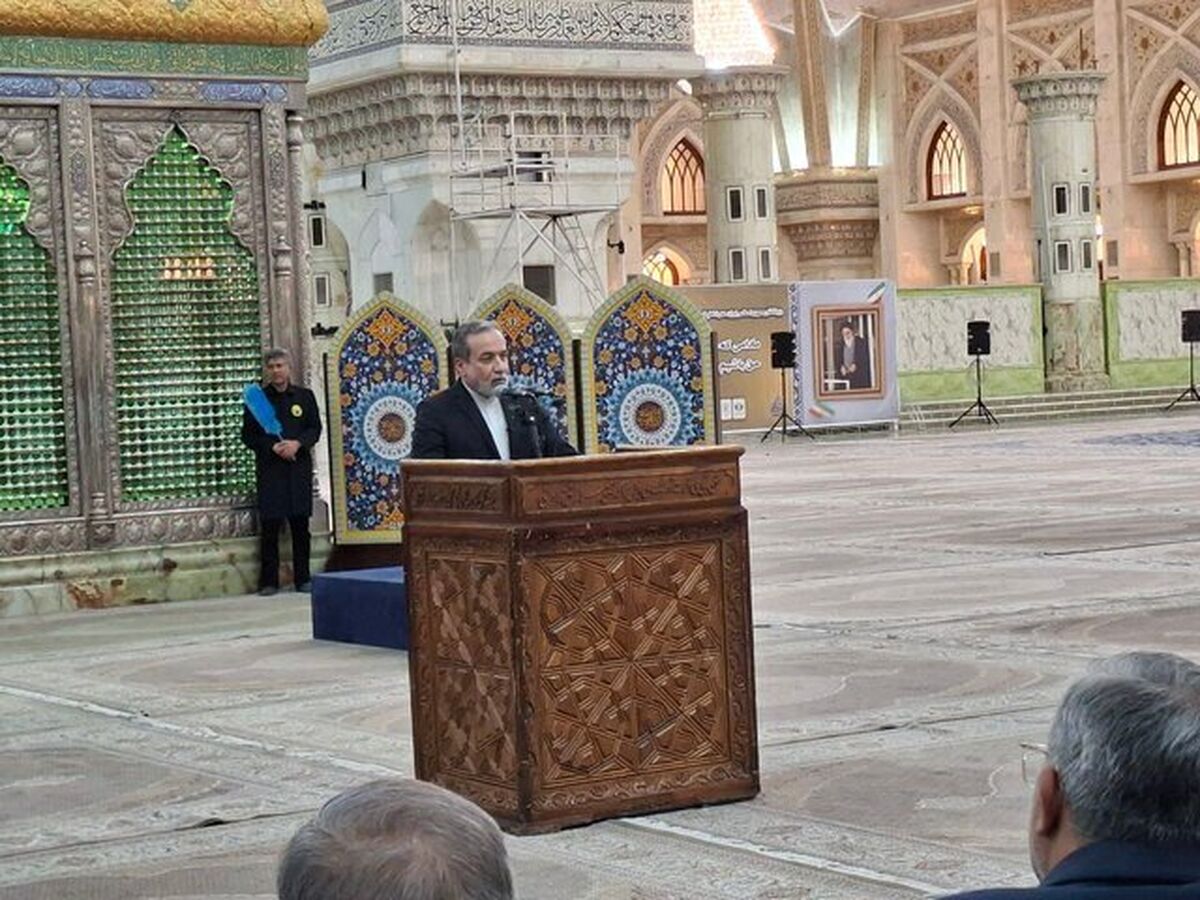
Seyyed Abbas Araghchi spoke on Monday afternoon during a ceremony to renew allegiance to the ideals of the late Imam Khomeini. Reflecting on recent events, he stated: "During the 12-Day War, the Iranian people chose resistance, guided by the wisdom of the Supreme Leader and the self-confidence instilled by the late Imam." He added: "The 12-Day War demonstrated that through resistance, sacrifice, and standing firm, heavy weaponry can be defeated; as Imam Khomeini said, blood is triumphant over the sword."
Protest is the Inalienable Right of the Iranian People
Referring to recent developments within the country, Araghchi emphasized: "Protest is the inalienable right of the Iranian people." He further clarified: "What we witnessed from January 8th (18th of Dey) onward, and the events that unfolded during those three specific days, was a continuation of the 12-Day War. Terrorist elements intervened. We must distinguish the ten days of protests from those three days. As I have stated before, those three days were an extension of the 12-Day War, in which the enemies ultimately failed to advance their objectives."
Men of War, Men of Diplomacy
Araghchi expressed hope that the blessings of this resistance would manifest in the country's foreign policy, stating: "While we have always been men of war, we have also always been men of diplomacy. We have never abandoned diplomacy and have never missed an opportunity to secure the interests of the Iranian people."
The high-ranking diplomat of the Islamic Republic of Iran added: "We are in the same trench as the Armed Forces; they perform their duty, and we perform ours in the diplomatic apparatus. We all move toward securing the interests and safety of the Iranian people." He noted: "After failing in this recent conspiracy, it is the enemies who are once again speaking of diplomacy. We are ready for diplomacy, provided it is from a position of equality, respect, and mutual interest. One must speak to the Iranian people with respect. Anyone who speaks to the Iranian nation with respect will receive a response within that same framework, and anyone who chooses to speak with force will be answered with force."
He reiterated: "We are ready for diplomacy, but diplomacy is incompatible with intimidation and threats; in fact, diplomacy has its own principles."
Standing Against the Aggressor
In another part of his speech, the Foreign Minister recalled the onset of the conflict: "On the first day of the war, as I was heading to the Foreign Ministry, I was reminded of September 1980, when Iraq attacked Iran. At that time, when the attack occurred, Imam Khomeini said 'nothing has happened; some thieves have thrown a stone into a well and they will be answered.' I told myself then that we are in a similar position; they have come and attacked, and we will give them their answer. Just as we stood against the aggressor during the eight-year war, we stand against the aggressor now."
The 12-Day War: A Turning Point in Iranian History
Araghchi described the 12-Day War as a turning point in Iran's history that warrants years of documentation and discussion. He recounted: "At that time, the U.S. President tweeted, insisting that Iran must surrender unconditionally, while simultaneously speaking of negotiations. We responded that we were already in the process of negotiating when the war broke out; therefore, the war must stop for negotiations to occur. However, they claimed that a ceasefire could be one of the results of the negotiations."
The Foreign Minister concluded: "During the 12-Day War, the Iranian people chose resistance. From the very first night, the response of our Armed Forces to their attacks began and continued. Consequently, by the twelfth day of the war, those who had demanded Iran's unconditional surrender were the ones proposing an unconditional ceasefire. This was the result of the will, self-confidence, and resistance of the Iranian people—a self-confidence we learned from the Imam and the path of the Supreme Leader."